TinyTeller
EnglishEN

Auditory bombardment, at home

Record once. Hear it every day.

Every day your child hears a short list of words with the same sound, each word a few times in a row. You or the speech therapist record them just once. Your child puts on headphones and listens. That is all they need to do.

Coming soon to Google Play too

  • Download on the App Store
  • Google Play (coming soon)

Are you a speech therapist? Try TinyTeller free for a month.

This is what a listening moment sounds like: each word a few times, calmly, one after another.

What is auditory bombardment?

A common exercise in speech therapy, and often the homework that comes home with you.

  1. A short list, one sound

    A handful of words with the same sound, for example cookie, cat, kite and book for the k.

  2. Heard often and calmly

    Each word a few times in a row, a few minutes every day. Always just as calm, always the same voice.

  3. Just listening

    Your child does not have to repeat anything or look at anything. Listening is enough.

It is part of the cycles approach by Hodson and Paden. Which words and how often is for your speech therapist to decide. TinyTeller takes over the reading aloud: record once, and hear it every day.

How it works

  1. This week's words, all at once

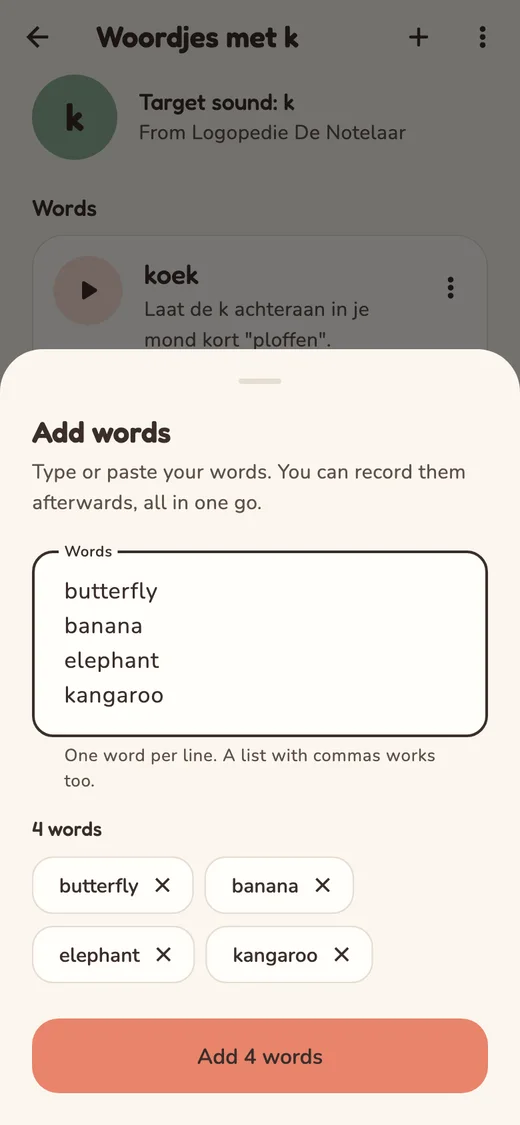
    Type them, paste them from a message or, on an iPhone, scan the therapist's sheet. The whole list is there in one go.

    App screen: four words typed into one field, ready to be added
  2. Record them once

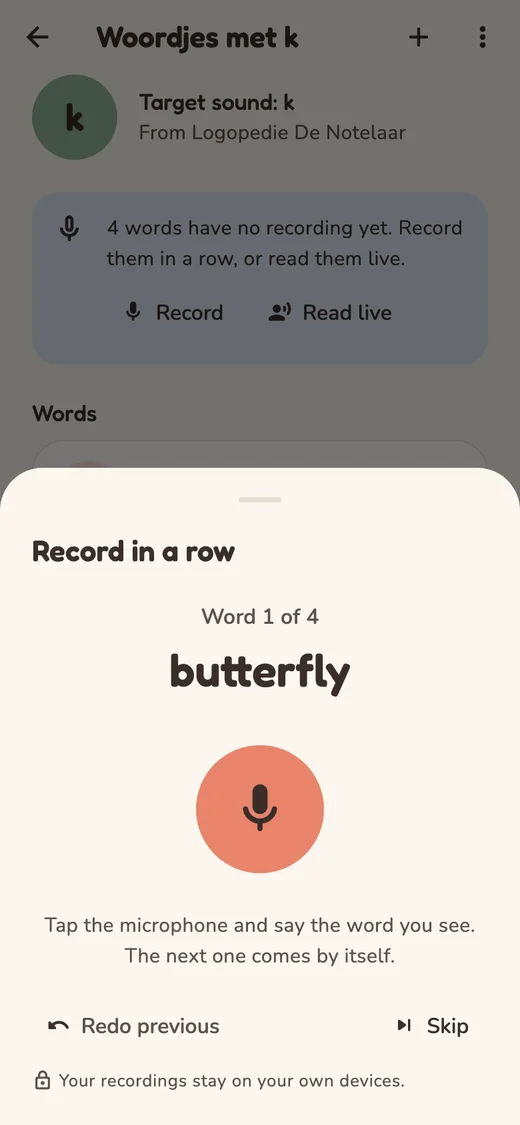
    Tap the microphone and say the word you see. The next one follows by itself. Got a code from the therapist? Then the words are already recorded.

    App screen: the word butterfly with a large microphone button
  3. Hear it every day

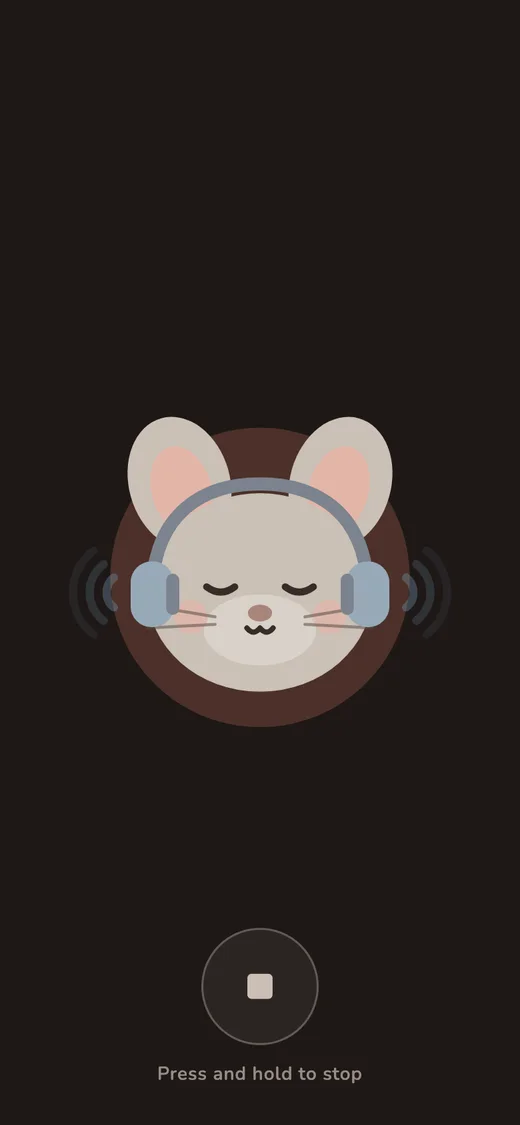
    Headphones on, press start. The screen stays dark and calm, and the mouse listens along. After a few minutes it stops by itself.

    App screen while listening: dark, with the listening mouse

For parents

The same list every day, without reading it out every day.

  • A reminder, so you don't forget

    Listening is easily forgotten. Pick the days and the time: the app gives a gentle nudge.

  • One code, and you are linked

    Type the code from your speech therapist or scan the QR code. New lists then arrive in the app by themselves.

  • No account

    Open the app and begin. Your recordings and your child's first name stay with you, even when you link a second phone.

  • See what was listened to

    The log shows when your child listened. Handy to show the speech therapist.

  • For each child

    More than one child? Each has their own lists and reminders.

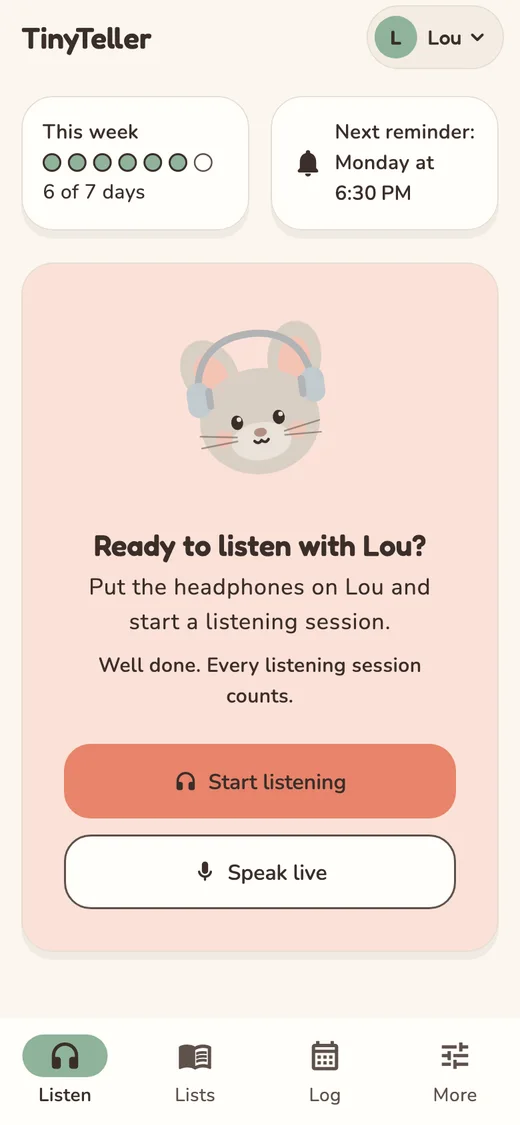
The app's home screen for parents, with the button Start listening

For speech therapists

Auditory bombardment at home, in your own voice.

  • Record once

    Every word goes into your library and can be reused in any list.

  • A list in a few taps

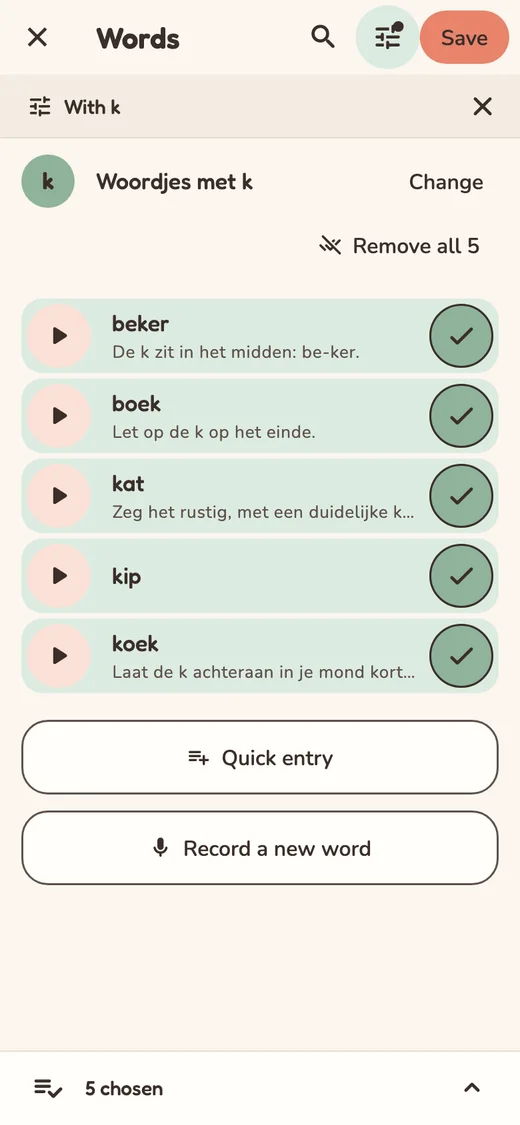
    Pick the target sound and tick the words, or type this week's list in one go.

  • Hand it over with a code

    The parent scans the QR code or types six characters. Link a child, and new lists arrive by themselves.

  • No file on the child

    About a child, your account only keeps the label you choose. Parents have no account.

App screen for speech therapists: choosing the words of a list

Get started as a speech therapist

Create an account in the app. Your first month is free, with up to 3 children, and you give no payment details. To carry on, you get an invoice for a year. Parents notice nothing and never pay.

Coming soon to Google Play too

  • Download on the App Store
  • Google Play (coming soon)

Pricing and free month

Calm and safe

  • Recordings stay in the family

    What parents record stays on their device. Link a second device and it travels encrypted: only your devices can read it, not us.

  • No ads, no trackers

    The app measures nothing and follows no one. It carries no advertising.

  • Gentle on little ears

    With headphones the app never plays at full volume, and it warns you when the device is too loud.

  • Nothing for your child to operate

    No games and no rewards. Just listening.

Where does TinyTeller come from?

TinyTeller started at home. Every week a dad got a sheet of words from the speech therapist, to read to his child. He wanted to help as well as he could and looked for something simpler than pen and paper. So he made a small tool: record the words once, and listen a little every day.

What began as a helper for his own child is now an app for other parents and their speech therapists. It remains what it was: an aid, not a treatment.

Questions and answers

What does TinyTeller cost?

TinyTeller is free for parents. Speech therapists try the app for 1 month free, then pay €50 a year, excl. VAT. The Pricing page has the details.

Does my child have to repeat the words?

No. Listening is enough.

Does my child look at a screen?

No. TinyTeller is made to be as screen-free as possible for children. You start the listening moment; your child puts on the headphones and listens. The screen turns dark, and there is nothing for your child to look at or tap. Feel free to put the device aside, with the app left open.

Do I need a speech therapist?

You can make your own lists, but TinyTeller is meant to support speech therapy. Choose the words together with your speech therapist.

Which devices does it run on?

iPhone and iPad, and Android phones and tablets.

Can we each listen on our own phone?

Yes. Link the phones once with a QR code, in More under Family devices. After that the words, recordings, settings and logbook are on every device, up to 4 devices per family. Everything travels encrypted: only your devices can read it, not us.

Which headphones do I need?

Any headphones that connect to your phone or tablet will work: wired or Bluetooth. Our preference is children's headphones with a volume limit (85 dB maximum) and noise cancelling: they keep out the sounds around your child, so the words are clear at a low volume. They are not required. Only when you read the words aloud live (Speak live) do wired headphones work best: over Bluetooth your voice may sound slightly delayed.

Which languages?

Dutch, French and English. You record the words yourself, so they can be in any language.